Resources for Students
The essential historical facts about Goya
Born in Fuendetodos, near Saragossa, Spain on March 30, 1746
Died April 15, 1828 in Bordeaux, France
Goya was a professional portrait painter (i.e., this is how he earned his living) who was also a "realist" painter who unintentionally presaged modern painting because of the subjects he chose (war, oppression, foibles of society) and the manner in which he depicted them, specifically without praising or glorifying institutions or famous persons.
He is often called the "father of modernism" especially for having painted "The 3rd of May" and for how he depicted scenes in some of the black and white etchings that he created.
The newspaper the UK Guardian published this accurate and typical "back story" about Goya in 2006:
"Francisco de Goya was a Spanish court painter who turned gradually from portraits of royalty and nobles to subversive depictions of everything from war and the inquisition to monsters and priests. Born in 1746, he slowly gained fame as a portrait artist, thanks to a series of Spanish monarchs who became patrons. He went deaf in 1792, apparently due to the poisons contained in his paints. Obsessed by the French Revolution and philosophy, he turned out a a series of troubling aquatint etchings known as Los Caprichos...
He is credited with being one of the first artists to describe the full horrors of warfare..."
For a complete time-line of events in Goya's life, go to:
Ways to cite this web site:
1. Based on MLA (Modern Language Association) Citation style:
Weems, Erik. "Goya Page Title." Francisco de Goya y Lucientes - Famed Spanish artist 1746 - 1828, 1 October 2008, http://www.eeweems.com/goya/goya-resources-for-students.php. 22 October 2016.
[For further examples of MLA citation styles, see the Purdue Owl Writing Lab Page]
2. Based upon the Chicago Manual of Style. For your footnotes or endnotes you may cite as:
1 Erik E. Weems, ed., Francisco de Goya Website, 5 April 2006, eeweems.com/goya, <http://eeweems.com/goya>, Timeline of Goya's Life.
[Note: change the date above which is in bold letters with the date you used this website. Substitute the page titled, "Timeline of Goya's Life " with the page that you are noting in your schoolwork.]
Additional citations should be in the form of this example:
2 Weems, Introduction to Goya [or use the appropriate author and title]
3 Ibid., Review of Images of Women Exhibit [ or use the appropriate author and title]
Goya Timeline
A timeline of events in the life of Goya is online here.
Museums in which there are at least five Goya paintings for viewing:
UNITED STATES
BOSTON
Museum of Fine Arts
CAMBRIDGE
Fogg Art Museum
CHICAGO
Art Institute of Chicago
DALLAS
Meadows Museum
NEW YORK
Frick Collection
Hispanic Society of America
Metropolitan Museum of Art
WASHINGTON DC
National Gallery of Art
EUROPE
FRANCE
Bayonne Musée Bonnat
Paris Musée du Louvre
Lille Musée des Beaux Arts
GERMANY
Berlin Staatliche Museen Preussischer Kulterbesitz
Hamburg Kunsthalle
Munich Alte Pinkothek
NETHERLANDS
Rotterdam Museum Boymans-van Beuningen
SPAIN
Madrid
Biblioteca Nacional; Calcografia Nacional; Fundacion lazaro Galdiano; Museo del Prado; Palacio Real; Real Academia de Bellas Artes de San Fernando; Real Academia de la Historia; San Antonio de la Florida
Valencia
Museo provincial de Bellas Artes
Zaragoza
Basilica of Our Lady of the Pillar; Charterhouse of Aula Dei; Museo Provincial de Belles Artes
SWEDEN
Stockholm Nationalmuseum
SWITZERLAND
Winterthur
Sammlung Oskar Reinhart "Am Romerholz"
UNITED KINGDOM
London
British Museum; National Gallery
AMAZON
Goya The Terrible Sublime - Graphic Novel - (Spanish Edition) - Amazon


"From this headlong seizure of life we should not expect a calm and refined art, nor a reflective one. Yet Goya was more than a Nietzschean egoist riding roughshod over the world to assert his supermanhood. He was receptive to all shades of feeling, and it was his extreme sensitivity as well as his muscular temerity that actuated his assaults on the outrageous society of Spain." From Thomas Craven's essay on Goya from MEN OF ART (1931).
"...Loneliness has its limits, for Goya was not a prophet but a painter. If he had not been a painter his attitude to life would have found expression only in preaching or suicide." From Andre Malroux's essay in SATURN: AN ESSAY ON GOYA (1957).
"Goya is always a great artist, often a frightening one...light and shade play upon atrocious horrors." From Charles Baudelaire's essay on Goya from CURIOSITES ESTRANGERS (1842).
"[An] extraordinary mingling of hatred and compassion, despair and sardonic humour, realism and fantasy." From the foreword by Aldous Huxley to THE COMPLETE ETCHINGS OF GOYA (1962).
"His analysis in paint, chalk and ink of mass disaster and human frailty pointed to someone obsessed with the chaos of existence..." From the book on Goya by Sarah Symmons (1998).
"I cannot forgive you for admiring Goya...I find nothing in the least pleasing about his paintings or his etchings..." From a letter to (spanish) Duchess Colonna from the French writer Prosper Merimee (1869).
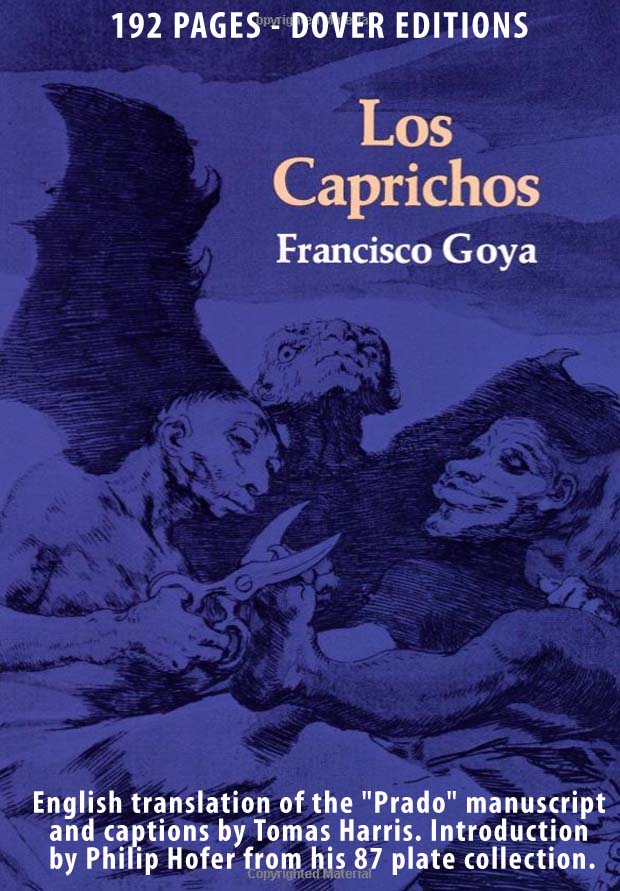
GOYA : Los Caprichos - Dover Edition - Amazon