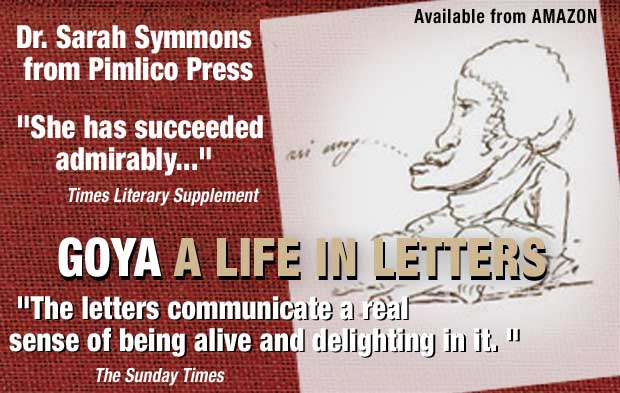
Dr. Sarah Symmons
Goya Expert
Goya Discovery
Site covering Goya authentication issues
National Gallery of Art: Goya
Washington DC Museum with an important Goya collection online
Goya at the Prado
(in Spanish) The Museo del Prado easily has the largest and most important collection of Goya images in the world
Goya at the Louvre
Collection in Paris of Goya images

Francisco de Goya: Pilgrimage to San Isidro, painted 1820 -1823 View enlargement
A landmark that appeared in several Goya artworks has won a reprieve from development from the Spanish High Court.
Anita Brooks at the UK Independent:
Environmentalists battling to save a popular green ridge in old Madrid depicted in Francisco de Goya's painting La Pradera de San Isidro have won a reprieve from development. The slope, known as the San Francisco cornisa, looked about to join the concrete jungle last year, when Madrid's city hall gave permission to the Catholic Church to build a vast complex there. The regional high court has ruled that the plan violates land-use laws for historic properties. The deputy mayor, Manuel Cobo, has vowed to appeal.
[Below] Drawing of the Isidro area, by Goya


National Gallery: Close Examinations
Article by Michael Kimmelman about the science that is now brought to bear and understanding (and verifying) works of art. As the tools become more precise, the reliance on 'eye technique' fades a little more.
Exhibit is at the National Gallery in London. Runs from June 30 to September 12, 2010
Coverage of the "Close Examinations" exhibit at the London National Gallery from the New York Times:
At first blush “Close Examination: Fakes, Mistakes and Discoveries,” here at the National Gallery, has the quaint, cheerfully scholastic earnestness of a science fair. Some 30 pictures from the permanent collection, most of them culled from storage, have been enlisted to anchor a flurry of wall texts, X-rays and the sort of enlarged microscopic cross sections of layered pigments and varnish vaguely resembling the cautionary photographs of plaque that elementary school teachers flourish before floss-wary fourth graders.
A celebratory primer on polarized light microscopy and other cumbersomely termed diagnostic tools employed by conservators today to determine when and how a picture was made, the show may sound like homework.
But it isn’t; far from it. It’s one of those gems, which, amid the hard science, stumbles onto squishier truths about what we are really looking for when we look at art. Out to instruct us in the chemistry of painting, it ends up suggesting how elusive art remains despite all the gadgets that we devise to master it.
...There is, for example, the Italian Renaissance painting of a young woman, brunet, demure and wide-eyed, standing before a window, that entered the National Gallery’s collection in the mid-19th-century. Was it by Lorenzo Lotto or Palma Vecchio? Experts debated. Either way, she was a beauty, they agreed, despite her blemish: a layer of damage visible just beneath her hair, which conservators only got around to checking in 1978. They discovered — you guessed it — that the demure brunette covered up a sultry blonde whose hair had been darkened, jaw line and brow softened, eyes widened and breasts made more discreet to contrive what the unknown “restorer” more than a century ago thought fellow Victorians would regard as a comelier Renaissance portrait.
The original was still Italian, still Renaissance, although hardly like the faux-Renaissance version that masked it. To modern eyes the cleaned picture looks more striking, while the shenanigans that passed for conservation a century ago only prove how taste is hostage to its era.
I would like to see as thorough an examination done of the Goya paintings that are in the museums. Records indicate, for example, that much repainting had been done to the Goya Black Paintings during restoration efforts, perhaps even altering the actual figure positions and placement in some cases.
In the Sharon Waxman book Loot: Stolen Treasures of the Art World, she recounts a sometimes bewildering tale of how museums can trick others, trick themselves, or simply get taken by crooks selling artworks. In discussing some of these items, for example marble objects from the mediterranean, she shows how a museum could "restore and clean" something while actually bleaching the object with chemicals to brighten and "whiten" it in order to change the object to fit the expectations of the viewer, when in fact the original state of the marble was a different hue and painted.
Along these same lines, the Orson Welles documentary F for Fake shows how talented forgers create art that passes the 'eye test' to get into galleries and museums, and that manipulation sometimes doesn't just depend upon painting or sculpting something to look like some famous artists work, but to flatter the experts who guard the gates into the art world of lucrative sales.

Goya: la maja vestida
Kay Sluterbeck at the Van Wert, Ohio Times-Bulletin online examines this famous Goya painting:
La maja vestida, known in English as The Clothed Maja, portrays the same beautiful, dark-haired woman, clad in a clinging white garment, reclining on a bed of pillows. The two pictures are usually hung next to one another. No one has ever discovered the model's identity, or why the paintings were created.
Both of the paintings are recorded as first belonging to the collection of Prime Minister Manuel de Godoy, Duke of Alcudia. Some art historians conjecture that the woman is his young mistress. However, it has also been suggested that the woman is Maria del Pilar Teresa Cayetana de Silva y Alvarez de Toledo, the 13th Duchess of Alba. Goya was rumored to have been romantically involved with the duchess and did several known portraits of her. But other scholars feel that Pepita Tudo is a more likely candidate. Still others think that the woman is actually a composite of several different models. None of these theories have been verified.
In 1815, the Spanish Inquisition saw the two paintings hanging side by side and hauled Goya in for questioning. He was told to reveal who commissioned him to paint the "obscene" La maja desnuda (The Naked Maja). No one knows if Goya revealed the client's name, or if Goya was tortured (not uncommon with the Spanish Inquisition). No records with this information have ever surfaced. However, the Inquisition confiscated both works from the Prime Minister, stating they were "obscene". They were returned in 1836
It seems reasonable that the paintings were commissioned by Manuel Godoy. The first appearance of this image (and its sister-painting, La maja desnuda") in historical records is in the 1808 inventory of Manuel Godoy's artworks (which also included the Velasquez 'Toilet of Venus' which was received by Godoy from the Duchess of Alba at her death in 1802.) The 1808 inventory refers to the paintings as 'gypsy's' (gitimas).
Jose Guidol, in his book Goya (1964) suggests the paintings were surely executed before 1800. Many scholars think the paintings were probably used as descrete decorations at Godoy's Madrid palace. Goya had painted a portrait of Godoy in 1801 (which referred to him as the "prince of peace" for his diplomatic work). This was before Godoy's complete fall from grace and eventual exile from Spain for the rest of his life when King Ferdinand (who hated Godoy) succeeded his father Charles IV.
Some historians consider the images to be paintings of Godoy's long-time mistress Pepita Tuda, whom he eventually married in 1832.
My opinion is that the pair of images are composites and not based upon actual live painting with a model. A stiffness not found in other similar poses in other Goya paintings is present; additionally, the heads appear to have been remodeled after the body forms were painted. This would lend credence to the idea that the paintings were of a specific known person (the Duchess of Alba, or Godoy's mistress Pepita Tuda); but during the turmoil and strife of the Napoleonic invasion, and eventual restoration of the powers of the Inquisition, it would have been prudent to disguise the identity of a well known personage appearing in a (forbidden at that time) nude painting.
A professional artist of Goya's caliber and skills easily painted and drew images without any model present. With familiarity with just about any person, he would have been able to make an identifiable portrait image (and certainly did so in many instances, particularly in his lampooning and satirizing in Los Caprichos) without needing access to the person in question.
However, the level of realism in Goya's "live" portraits supercedeswhat's here in the Vestida and Desnuda.The embellishing level is the same, but the drawing quality is not. This difference in application of skill in these images is my basis for questioning whether La Maja Desnuda or La Maja Vestida are from actual live modelings session at all. But this is all conjecture.

[Image from Arseneau's article on the 'forged' Goya prints]
Gary Arseneau attacks the National Gallery of Canada's Goya show for using the late edition plates from Goya's Disasters of War series printed well after Goya's death. In a fairly succinct critique, Arsenau explains the chronology of Goya's work with the Los Desastres de la Guerra series, comparing the National Gallery set now on display against the rare 1810 edition that Goya gave to his friend Cean Bermudez. Arseneau then attacks the etching printings of 1863 onward (which are the versions available in most Goya books and presented at museum shows. These are a slightly truncated set of 80 images from the the complete run of 83 known, not counting the rejected plate "infamous advantage" which Goya apparently dropped from the series, though reusing some elements in plate #22.) Arseneau also specifically attacks the ethics and the lack of explanation from the National Gallery of Canada for not pointing out that what they are presenting is not a true version of Goya's work.
Well worth reading. The argument could apply to many works of art that exist in private and public collections: original pieces that were changed or modified after the author no longer had contact or control over the piece. In particular, Goya's Black Paintings are known to have been retouched a number of times for the sake of preservation, but historical records indicates some of the retouching went much further and actually altered some images.
Interesting article about the technology now being used to photograph detail of paintings from the Prado collection at a resolution not ever used before, far outdistancing the previous limits of digital and analog cameras. Read here at the Vromo blog in original spanish or in translation to english.
Also, read the article at the UK Telegraph (english) discussing the Google system and what they're doing.
A certain amount of irony is probably unintentional in this exhibit of 33 images from Los Desastres appearing in Ho Chi Mihn city as part of the celebrations for the 1,000 anniversary of the city Hanoi and the 35th anniversary of the liberation of the South. The exhibit totals 46 pieces altogether from the Hans Guggenheim collection. The event is sponsored by the Ho Chi Mihn City Fine Arts Association and the Viet Nam Fine Arts Association. Complete article online at the Vietnam News Agency.
The digital catalogue raisonné of Goya works we reported on from February 26 is nearing completion. The cover has been released. This comprehensive 'alternative' catalog effort is led by Prof. Amparo Sacristan of Mataro University in Spain:
For an overview of why this is an important step forward in the contentious dialogue between art experts, museum officials, and consumers who own authenticated (and unauthenticated) works by Goya:
• English language version of a Spanish article at interviu.com which discusses the mostly closed world of art authentication when it comes to a "brand" as important as Goya:
If Goya creates problems it is because Goya is still on the market and the trials and responsibilities of his catalog have significant influences on the market. The bottom line is so clear that even the director of the Museo del Prado, Miguel Zugaza, admitted in 2008, as tensions with Goya are a matter of business...
The scandal last year with the colossus - the Museo del Prado decided to remove the authorship of Goya against the opinion of many experts, it was just a spark in a thick canvas of interests where art historians, foreign experts, money auctions, officials of the Prado, private collectors and even scientists battle for authority.
At the bottom of this mess would be the certificate of authenticity of the paintings of Goya. Or put another way: How many works not listed may be by this painter, and how many of which hang in prestigious institutions would are not from his brush? Is there a "Goya lobby"?
• Professor Antonio Pereles. Probably the leading exponent of the "Goya graphism" method of authentication. Using the usual technical tools of analysis, Pereles added to this a comprehensive effort at understanding and recognizing the "hidden" Goya signatures that occur on many accepted (and unaccepted) Goya works. Unfortunately, Pereles recently died, but his efforts as a long-respected restorer and then controversial authenticator has had a major impact on what is going forward in the battle between the Prado experts and those aligned in Spanish academies and art collection circles outside of the museum system.
• Goya Discovery: Probably the best English language source for information about the struggle between the "scientific method" of authentication and the subjective "eye-technique" when it comes to Goya.
About the 'scientific method' and the 'subjective eye technique': Neither term accurately pinpoints where the division between the two methods occurs, since both utilize tools that are in the provence of the other. Both use chemical analysis, x-rays and historical research through written records contemporary to Goya. Also, each use the same lists of known Goya works from the time following Goya's death when his works were being sold off by his heirs.
What is more distinct is the situation now for these two camps, one inside and one outside of the Prado museum. The frustration of owners of paintings which on balance probably are by Goya, but who face a barricade when it comes to having them accepted in the world of the museum and that of the lucrative, high-paying auctions, is pressuring a move forward getting tools of authentication accepted that will supercede the opinions of two specific Goya experts: Goya curator Manuela Mena Marqués and longtime Goya authority Juliet Wilson Barreau.
Without a strongly supported provenance proving parentage, a painting is left to other devices to demonstrate its authorship. Unfortunately, the current trend is to sensationally discredit Goya paintings at the Prado, versus identifying and adding to the list of known Goya works. Perhaps this is a reflection of the tension within western museums on the whole, where forgeries sometimes surface, embarrassing more than just a staff, but also the endowing agents who are the source of much of the support money that keeps an expensive enterprise like a museum going. There is also the struggles over ownership of objects that may not have entered a museum collection through verified legal means.
I received news from the goyadiscovery site that after a long illness, Professor Pereles has passed away. Below is a spanish language video of an interview with the professor about Goya. I am searching for an obituary of Mr. Pereles that I can link to and possibly provide on this web site.
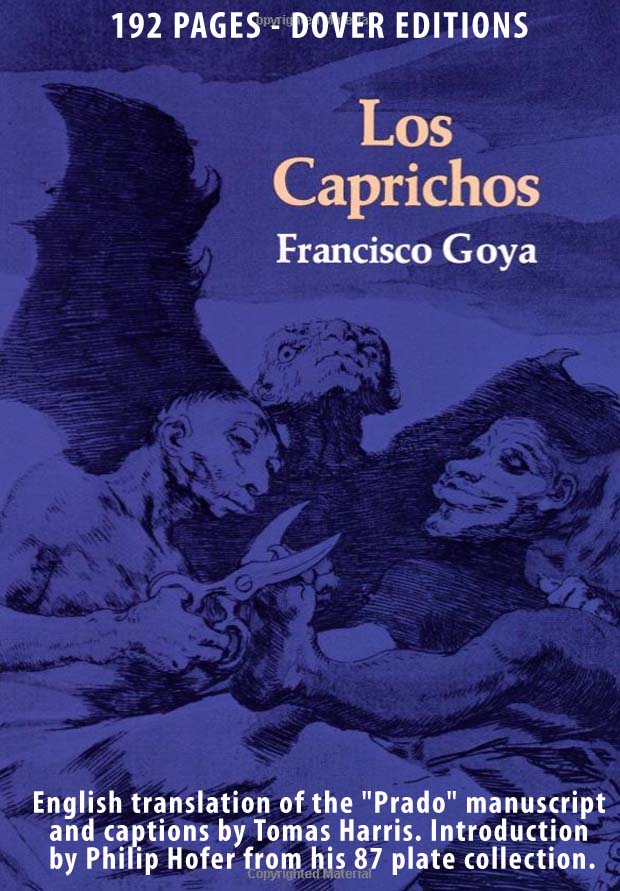
The English language newspaper The Baltic Times carries a review of the current Goya Los Caprichos exhibit in the Lithuania Capitol of Vilnius.The 78 etching presentation (A complete set of Los Caprichos contains 80) is being shown at the Vilnius Picture Gallery, which is situated on Didzioji Street 4 in Vilnius’ Old Town.The etching set is from an 1806 edition, and an interesting note is made about their condition and why there are only 78 pieces:
These etchings were shown for the first time in the fall of 2009, in Riga. In 1930, the etchings were brought to the Riga City Art Museum by some unknown art collector. The documentation of art purchases was not so strict in those times and the name of the seller remained unknown. The original Los Caprichos has 80 etchings. The museum in Riga purchased 78.
According to Daiga Upeniece, head of the foreign art department of the Latvian National Museum of Art, the two etchings, which were not bought, are extremely scary - they show torture of children, and could be the reason why they were not bought by the museum.
The prints are sensitive to light. This is why, after the exhibition in Vilnius, which will be closed on May 18, the etchings will ‘rest’ in storage at the Latvian National Museum of Art for the next two years.
A new diagram showing the position of the 'Black Paintings' on the walls of the Quinta de Goya. A large image of the diagram is online on the page about Xavier de Salas' material on the Black Paintings.
The site goyadiscovery has long been working toward a scholarly alternative to the traditional authentication methods of the past century. In particular, the site has championed the work of Goya expert Antonio Pereles. They have now announced an effort at a digital registery of Goya works:
The catalogue in question is now being worked on and it will contain a body of yet undiscovered Goyas paintings and etchings that have all been subjected to the strictest digitalized, computerized examination following the procedures and quality standards of the Technical University of Mataro,Spain copyrighted method..
![]()
In particular are the efforts about Goya graphisms (or micro-signatures) used to distinguish Goya works, which is a field Dr. Pereles has labored on.
In reference to this subject, the Polytechnics School of Mataró in Spain has released an academic paper describing a digital method for examining Goya works. This is one of the methods adopted in the effort on the digital catalog of Goya art works. From the paper:
Goya is one of the greatest painters of 18th century. Goya taught a lot of students his technique and style of painting and drawing in his school, so there are a lot of works that are not authentic of Goya but they can be catalogued as Goya’s, because they were made by their disciples. Also, some contemporary painters imitated and falsified Goya’s work [Mor94]. Goya constantly experimented on new techniques and broke his own rules, developing a very sharp style [Sch07]. He mixed portraits, self-portraits, landscapes, religious themes and others. So the work of the expert specialists is very hard as they must study a lot of parameters in each work of art.
After studying a great number of Goya’s work, it is possible to claim the next hypothesis [Veg91]: “Goya carried out his work with characteristic strokes, made up with spelling of his surname (G – o – y– a). He shaped to lines, outlines, light touches, shadows, contrasts, … always being covered up”.
These small prints are called graphisms. Different authors have shown those small prints in Goya’s work ([Med70], [Fau96]) as particular characteristics of painter. But since the works of [Agu97] and [Rod99] the extraction of this characteristic was not automated. Another work [Veg00] was previously made but this one was not automatic.
...This work does not intend to look for signatures as other authors have done. It only looks for small prints present in Goya’s work ([Agu97], [Rod99]). Other painters’ works of art were processed with this application but graphisms were not localized. In general, all of segmented areas were classified as no-graphisms, only in few cases the Graphisms Recognition localized some lines as graphisms ‘A’ and ‘O’, which are not significant. Other painters’ works of art (Velazquez, Dalí, Picasso and Fortuny) have also beeen analyzed to prove that lines as graphisms were not unwilling painted in Goya’s.
The entire paper is well worth reading, and I am seeking permissiion to present the entire piece online here at this web site. Meanwhile, goyadiscovery has the PDF of the article online for download.
The AGA (Art Gallery of Alberta, Canada) has a full exhibit presenting the Goya etchings sets of The Disasters of War (Los Desastres de la Guerra) and Los Caprichos via a computer terminal.
An interesting review of the exhibit is online at the Edmonton, Canada site vueweekly.com written by Adam Waldron-Blain:
Goya's Disasters of War series is a powerful collection of images that leaves an overwhelming impression. The images, like modern photojournalism, are a collection of atrocities from the Spanish Peninsular War, and they wrap around the walls of the gallery in two rows. It takes a fair chunk of time to look through them all and to absorb the impact of their depressing content.
The exhibition at the AGA has taken pains to point out the political content of the works, and plenty of it is plainly visible even without extensive knowledge of early 19th century Spain. Most obvious is the emphasis on women, children and the elderly that not only makes clear the fact that atrocities are being depicted, but begins Goya's construction of a liberal heroic Spanish patriotism. The prints present a narrative about the common people of Spain resisting French soldiers in moments of great heroism and martyrdom. But the unreason of war, the relentless and apparently purposeless advance of the soldiers is impossible to stop, and the heroic citizens are inevitably dismembered and abandoned on the fields of war.

[Above] Plate 15 from The Disasters of War (Spanish: "Los Desastres de la Guuerra") This plate is titled "Y no hai remedio" ("And there is no remedy")
Hours at the Art Gallery of Alberta are:
Address:
Dr Sarah Symmons addressed the issue of animal anatomy in el Coloso in a brief article at the Spanish language news site ABC.ES. The 'clumsy' anatomy of bulls and donkeys was used as part of the basis for the Prado Museum's demotion of Colosus from the list of offically recognized Goya artworks.
When the horses were important, like in the Bullfighting, Goya painted them exquisitely . But when the horses performed a marginal function in a composition, for example in the Picture of Fernando VII, they assumed a clumsy, inanimate quality.
Read the entire article (in Spanish) at abc.es
Written by Lauren Adams, review takes a look at the Blanton Art Museum presentation at the University of Texas in Austin. Adams calls the exhibit "a captivating glimpse into the psychological state of Goya."
Goya’s Prints: The Dawn of Modern Art
Blanton Museum of Art
200 East MLK
Austin, Texas 78701
Through March 7, 2010
From the Dallas Art News web site review by Lauren Adams:
The prints are dark not only in their content, but also in their construction. If you take moment to view the prints housed the neighboring galleries, what you will find are smooth, clean lines and clear depictions of the moods and actions of the figures. Although some examples of Goya’s work does coincide with these observations, his most striking pieces are quite a contrast from this model. Many pieces, such as Disparate General, have a fast, sketchy quality to the scene. The figures loom in and out of large, inky shadows, with their faces shaded to the point of disfiguration.
The scenes are a jumble of metaphor and fear with an underlying current of deep revulsion towards humanity. Goya stresses how far man has fallen with the representation of shadowy goblins and devils hovering over figures and prodding them on their wicked ways. Although the devilish figures are haunting enough, what is most disturbing is the portrayal of the eyes of the human figures. The majority of the people, even those lurking in the shadows, have round, bulging eyes that seem to pop from their heads. This conveys a sense of madness within the figures, as if they are carrying out their evil deeds in a frenzied, dehumanizing trance.
Sotheby Old Masters auction in New York on January 24, 2010

Sotheby's describes the images as 6.75 x 3 inches in size (172mm by 101mm). Also;
RECTO: A YOUNG WOMAN ARRANGING HER HAIR BESIDE A BED ON WHICH ANOTHER WOMAN IS RESTING; VERSO: A YOUNG WOMAN SWEEPING IN A TAVERN
These images appear in Gassier's "The Life and Complete Work of Francisco Goya" on pages 171-172. They are numbered images #368 and #369 respectively. They are on the reverse sides of a single sheet of paper. The drawings are rendered in indian ink wash (ink diluted with water to enable grey tones).
Provenance for the drawings provided on the Sotheby's online lot description: Javier Goya y Bayeu, 1828; Mariano Goya y Goicoechea, 1854; Valentin Carderera and/or Federico de Madrazo, c.1855 - 1860; Jules Boilly, his sale, Paris, Hôtel Drouot, 19-20 March 1869, lot 48 (the album sold 450 FF, bought by Leurceau); Hyades, Bordeaux; A. Strölin, Paris; Private collection, Switzerland; Private collection, Paris
From Sotheby's text:
This double-sided page was part of the so-called Sanlúcar album and is among the best images from it.
...Gassier stresses the importance of the Sanlúcar album, saying that to his knowledge this is the first time that Goya uses wash on its own, and he again quotes Carderera, who eloquently describes the effect of this medium:'It is impossible to convey the clearness of the lines in most of these drawings, done with the very tip of the brush dipped in Indian ink...'. Goya's drawings up to this moment had been preparatory studies for paintings, executed in a classical technique of red and black chalks, so the Sanlúcar album represents a dramatic shift to a medium which became essential to him, particularly in the later albums..
September 15, 2009
From a speach by the UK Foreign Office Minister, Chris Bryant, addressing the Latin American Forum at casa de America in Madrid on September 14, 2009. The event was the Latin American Forum.
From the UK Foreign Commonwealth Office government web site:
I am not sure whether you know Goya's painting, The Colossus. It depicts a giant who is trampling over a landscape of destroyed villages. For Goya, the colossus then was Napoleon's imperialism, which he also presented in his paintings Second of May and Third of May. And their message still holds true today. The relationship between Latin America and Europe cannot be a neo-colonial or imperialistic relationship. It must be a relationship of equals.
More information about Goya's El Coloso
June 1, 2009
Goya etching prints from Los Caprichos (plates 31 and 59) are going on auction at the Galerie Kornfeld in Bern, Switzerland. They are estimating the sale at $6,774 (USD) for each individual print. The auction also includes six other etchings from La Touromaquia ("bullfighting" series) with estimate prices at approximately $5,000 USD (Note: the images int the Kornfeld catalog seem to had at least one error, for the print Lluvie de Toro. The representative image seems to be wrong.)
Plate 31 English title: "She prays for her" – apparent reference to 'prey/pray' and dealing with the relationship between a prostitute and her Duenna. Spanish title: Ruega por ella.
Plate 57 English title: "And still they don't go away." Spanish title: Y aun no se van!
Auction information:
Auction 247: Art of the 19th and 20th Centuries, Part II
Oil Paintings, Watercolours, Drawings, Sculptures, Prints, Ilustrated Books of the 19th and 20th Centuries as well as Contemporary Art - more than 700 numbers
Auction sale on Thursday, 11th of June, 9.30 a.m. (No. 176-513) and 2.15 p.m. (No. 514-880):Francisco de Goya
Title: Ruega por ella, pl. 31 (from Los Caprichos)
Medium etching, aquatint, drypoint and copper engraving
Size 7.9 x 5.8 in. / 20.1 x 14.8 cm.
Year 1798 - 1799
Cat. Rais. Harris, 66/III/1
Sale Of Galerie Kornfeld: Thursday, June 11, 2009 [Lot 312]
Kunst des 19. und 20. Jahrhunderts, Teil II
Estimate 7,500 CHF (6,774 US$)
Auction Info. Galerie Kornfeld
Laupenstrasse 41
Bern , 3008 Switzerland
Tel: +41 (0)31 381 46 73
Fax: +41 (0)31 382 18 91
Click here to email auction house
Bid Dept. Tel: +41 (0)31 381 4673
Click here to email the bid dept..
Regarding the La Touromaquia prints: an 1877 reproduction (from L'Art) sold at auction with Heritage for $717.00 in March 2009.
More information about the Goya Caprichos Prints
3 Goya Drawings auction at twice the pre-sale estimate
Reuters has reported on the 4 million euro auction price that came together for the three Goya drawings put up at Christies (London) July 8, 2008:
The drawings, sold by Christie's in London, were last recorded at a Paris sale of works by the artist in 1877 and all come from Goya's celebrated private albums.
They were sold from a Swiss private collection and were in "exceptional" condition because they were never framed or exposed to light.
The top lot of the three was "Down They Come", from album D called "Witches and Women", depicting four women fighting as they fly through the air.
It sold for $4.5 million (2.28 million pounds), a world record at auction for a Goya work on paper and more than twice the pre-sale estimate.
Results from recent auctions at Christies:
[Lot 65] Goya Drawing: Bajan riñendo - They Go Down Fighting

£2,281,250 ($4,514,594 USD)
From a private Swiss Collection
9¼ x 5 5/8 in. (234 x 143 mm)
From Goya Album "F"
From the Christie's auction notes page (attributed help by Juliet Wilson-Bareau):
Francisco José de Goya y Lucientes (Fuendetodos 1746-1828 Bordeaux)
Bajan riñendo (They go down quarrelling) or Vision de bajar riñendo (Vision: going down quarrelling) inscribed by the artist in black chalk 'Vision de bajar riñendo' (over 'Bajan riñendo') and numbered by the artist '2' in black chalk (corrected by him to '1' or possibly '5' in pen and ink) at upper centre (album D) and with Madrazo's number '47' (Madrazo album III) in pen and ink at upper rightbrush and grey wash, scraping 9¼ x 5 5/8 in. (234 x 143 mm.)
[Lot 67] Goya Drawing: Constable Lampiños stitched into a dead horse
"En Zaragoza à mediados del siglo pasado, me tieron à un alguacil llamado Lampiños, en el cuer- po de un Rocin muerto, y lo cosieron ; toda la noche se mantubo vivo"

£769,250 ($1,522,346 USD)
From a private Swiss Collection
8 1/8 x 5 5/8 in. (205 x 142 mm)
From Goya Album "F"
From the extensive notes at the Christie's web site:
It is one of the very rare drawings from Goya's private albums to be extensively annotated by Goya in pen and ink. The inscription reads: 'In Saragossa around the middle of the last century they put a constable called Lampiños in the body of a dead nag; and he stayed alive for the whole night'. One can see only the horrified head of the man stitched inside the dead horse (could the word 'rocin' used by Goya be a conscious reference to Rocinante, Don Quixote's horse?) in front of a large arch, with excited dogs barking, attracted by the animal's entrails which lie on the ground.
Although lost from view since its appearance in the Paris 1877 sale, the drawing has recently been revealed as one of the very few described in his Journal by William Stirling, later Sir William Stirling Maxwell (1818-1878), the pioneering English collector and historian of Spanish art, following a visit to Javier Goya's home in 1849...
[Lot 66] Goya Drawing: Repentance "Le repentir"

£959,650 ($1,899,147 USD)
From a private Swiss Collection
8¼ x 6 in. (210 x 152 mm)
From Goya Album "F"
From the Christie's extensive online notes about this drawing:
On the present drawing, the inscription in pencil and in French is a much later addition ['Le repentir'], probably copied from the 1877 Paris sale catalogue. This sheet was page '47' of the original bound album but it bears two other numberings applied by Federico de Madrazo. This shows that when Madrazo took it out of one of Javier Goya's large albums he evidently moved it from one to another of his own three albums.
Drawings from Album F are usually executed only in brown wash but on this one Goya also extensively used a bright carbon-grey wash to suggest the forms of rocks and the interior of a cave in the background, conveying a remarkable sculptural quality to the figure. The drawing, brushed with breathtaking freedom, has a finished appearance which is unusual in sheets from Album F. For the head (which was originally positioned further forward) and the hands, Goya has used with extraordinary virtuosity a thinner brush (but no pen) and a brown ink lighter in tone.
...this one does not seem to be part of a sequence.
...Goya also treated the subject of repentance in one of his last religious pictures, executed around 1820, now in the Phillips Collection, Washington, The Repentant Saint Peter.

One other note, the price on an appparent first edition of Caprichos Author portrait page:

£3,450 ($5,647 USD)
July 8 "Old Master Prints"
Christie's page on this item
New York Times on Goya 'War' Exhibit; also El Coloso
An overview of the exhibit "Goya in Time of War" at the Prado in Madrid, written up by Michael Kimmelman at the New York Times. He provides a few thoughts about the near-official reduction of 'Colossus' to not-Goya, which seems to be the opinion carrying the day in all of the reports I have been reading. Kimmelman also touches on the general status of Goya in art, and gives an opinion on the exhibit's size and scope:
There was a little orchestrated flurry of drama here at the Prado a few sweltering days ago when the museum staged a news conference to announce what was hardly news: that “Colossus,” the famous, much reproduced Goya painting of a giant terrifying a landscape, may not be a Goya after all. Experts had been questioning its authorship for years. Expert or not, anybody who bothered to look closely at the picture and not just glance at Goya’s name on the label next to it, might have felt doubts.
...the show (it remains on view through July 13) is most memorable for pictures less famous, some rarely or never seen — still lifes and portraits — many from obscure collections, which Ms. Mena, its curator, has finagled for the occasion.
These include swift drawings like “Cuantas Baras?” (“How Many Yards?”). It’s a minor masterpiece of condensed, sardonic understatement, with a priest in a voluminous robe that, seen from the rear, gives him something of the creepy aspect of a bat. Then there are paintings like the portrait of Goya’s grandson Mariano, standing, rosy-cheeked, beside his toy carriage, an image as tender as the priest’s is ruthless.
That is the genius of Goya, not just to give equal weight to drawings and prints and paintings, to public and private pictures, but also to move so effortlessly between cruelty and love. The human condition was never whole, Goya made clear.
"Colossus" by an assistant, claims Prado
The long-running dispute over 'Colossus' (also often titled "The Giant" or in the Spanish 'El Coloso') has been going on since at least 2001 when Goya scholar Juliet Wilson-Bareau stated the painting was probably by someone else. Research on this has reached the point that the Prado is virtually giving this opinion "official" status:
Danny Wood at the BBC online wrote:
The Colossus, painted early in the 19th Century, is traditionally attributed to Francisco Jose de Goya.
But museum experts now say that an investigation has revealed new information about the possible artist.
The revelations follow the identification of two initials - AJ - at the bottom of the canvas.
According to the Prado's investigators, those initials link the work to Asensio Juli, a friend and collaborator of Goya.
The painting depicts a giant walking through a landscape as people flee in panic.
The style of the Colossus was thought to be connected to paintings by the artist about Spain's war of independence against the French.
But, on the basis of their ongoing investigation, the Prado's specialists say they refute the view that Goya is the painter.
The identification of Asensio Juli seems to answer the caution given by Goya writer Sarah Symmons in our interview from 2006:
The question with Goya is that if he didn't paint works like The Colossus, the New York Majas, or the Black Paintings, then we have to find a new artist as their author. If there were such an anonymous artist who for various reasons wanted to keep their identity a secret, then it's a challenge to find out who they were. I know some people have suggested Javier Goya, but I don't believe that.
The UK Telegraph has more on the Prado announcement, written by Elisabeth Nash from Madrid:
... in an announcement set to raise a storm in the art world, the museum said yesterday that the celebrated El Coloso was not by the Spanish master after all, and was probably painted by a pupil in his studio.
In a devastating critique, the museum's chief Goya specialist said the painting, made during Napoleon's occupation of Spain after 1808 and long seen as one of the artist's most dramatic portrayals of the horrors of war, was "a pastiche".
"Stylistically, it is completely alien to Goya," said Manuela Mena, the Prado's senior Goya specialist who has studied El Coloso and doubts over its attribution for nearly 20 years. She also revealed doubts over at least three other Goyas held by the Prado.
..."The person who painted the bulls in El Coloso knew nothing about the anatomy of a bull – which Goya knew everything about," Ms Mena said. "The donkey looks like a furry toy, nothing like Goya's perfectly executed donkeys of the same period. None of the details correspond to the Goya we know."
Further reading: Our page on El Coloso
Two Concurrent Goya Exhibits running at Prado
The exhibit titled "The Spanish Portrait in The Prado. From Goya to Sorolla" has just opened at the Prado.This is the second half of a previous exhibit which traveled to various museums in 2005-2006. I have yet to see a list of paintings included with the exhibit.
And closing on July 13th is "Goya in Time of War" which has as its centerpieces the twin Goya paintings "2nd of May" and "3rd of May" which have been cleaned and restored. (See earlier news item about the restoration work).
From a review by Barbara Rogers at Spain-Travel.com:
The exhibit is so compelling that even those who thought they didn’t care much about Goya are drawn into the tumbled world of 18th-century Spain. Ranging from portraits of his royal patrons to etchings satirizing the follies of mankind and the “Disasters of War,” the show also includes the two monumental paintings that form the best-known artistic record of the abortive May 2 uprising.
El Prado Museo web page on Goya Exhibit
Exhibit information: General entry is 6€
Free admission: from Tues to Sat from 6 pm to 8 pm; Sun from 5pm to 8 pm
Advance booking tickets: telephone 902 10 70 77
Date 15 April to 13 July 2008
Curator: Manuela Mena, Chief Curator 18th-century Painting and Goya at the Museum
Jointly organised with the Sociedad Estatal de Conmemoraciones Culturales under the direction of the Ministry of Culture

The Goya Tiempos de Guerra Catalog for the exhibit is written by José Luis Díez, Chief Curator of 19th-century Painting at the Prado; Juan J. Luna, Head of the Department of 18th-century Painting and Goya; José Manuel Matilla, Head of the Department of Prints and Drawings; Gudrun Maurer, art historian and associate of the Museo del Prado; and Manuela Mena, Chief Curator of 18th-century Painting and Goya and curator of the exhibition.
Ben Sisario at the New York Times writes about the legal consequences of hijacking Goya's "Cart" Painting:
Two men who stole a valuable Goya painting are going to federal prison, The Associated Press reported. The men, Steven Lee Olson and Roman Szurko, stole “Children With a Cart,” from a transport truck in November 2006 as its drivers spent the night at a motel in Bartonsville, Pa. The work was on its way to the Solomon R. Guggenheim Museum in New York from the Toledo Museum of Art in Ohio. The painting, from 1778, was insured for $1 million.
Further reading on the failed Goya painting heist.
Art Daily reports on the discovery of three previously assumed 'lost' Goya drawings that are to come up on auction in July:.
Christie’s will offer 3 rediscovered drawings by Francisco José de goya y Lucientes (1746-1828) at the auction of Old Master and 19th Century Drawings on 8 July 2008 in London. Last recorded at a landmark auction of works by the artist in Paris in 1877, the drawings have been missing and presumed lost ever since, and represent the most important grouping of sketches by the artist to be consigned to auction in over 30 years. The three drawings, which will be offered individually, are expected to realise a total in excess of £2 million.
...On 2 April 1877, a landmark auction in Paris offered a series of 105 drawings taken from goya’s celebrated private albums. goya had started assembling personal notebooks or journals in 1796 and gradually filled the pages with imaginative drawings of people in various moods and situations, as both individuals and in groups. The drawings to be offered at Christie’s are taken from two of the artist’s albums, and present three differing styles and subjects.
The auction on July 8 occurs at 11 a.m. at the King Street, London location. There will be four days of viewing prior to the event.

artdaily.com news article
UK Telegraph Article about Goya Auction
The discovery of the sketches, in a Swiss private collection, has caused great excitement in the art world where they have been hailed as the most important of the acclaimed artist’s work to come to auction for over 30 years.
- From the UK Telegraph article
JUNE 5, 2008
A new organization coming from Miami, with an emphasis on Goya artworks, is organizing. Their web site is online but has little information. However, I have been told that they are in the early stages of putting together an exhibit of rare Goya art owned by private collectors.
JUNE 5, 2008
A local SoHo exhibit of a 4th edition set of 'Disasters' has been reviewed at the New York Times by Karen Rosenberg:
Francisco de Goya’s print series “The Disasters of War,” an extended portrait of the cruelty and aggression that accompanied Spain’s War of Independence in the early 1800s, has been used and abused by artists wishing to plumb the depths of human nature. (In a notorious example, the brothers Jake and Dinos Chapman purchased a rare edition and drew clowns and puppies over Goya’s images of victims.)
A complete fourth edition, published in 1906 by the Real Academia de Bellas Artes de San Fernando in Madrid, is now on view in SoHo. It will deliver a shock to anyone who thinks that the “Disasters” have been overexposed, or that black-and-white etchings can’t convey terror and intimidation with as much force as more modern mediums.
The exhibit runs through August 2008.
JUNE 4, 2008
The Helena P. and Ignacio V. Ponseti collection is on view in Iowa City at the University Pentacrest Art Museum. The show includes 6 selections from the 80-print Disasters of War series.